Monday, October 28, 2013

Meet the Staff Interview: Ben Croomes

Ben Croomes
Major: SociologyYear: Junior

What do you like to do in your spare time?
I have a lot of hobbies. I've been an amateur carpenter for a few years.
What’s the best advice anyone has ever given you about writing?
I was in a group of writers that consisted of myself and 5 elderly women. After reading one of my short stories, the oldest of the group said, "It doesn't make sense. It should make sense." The simplicity of her statement killed me, but it's also stuck in my head.
What has been the most rewarding part of your job at the Miller Writing Center?
The people I've met. Every client I've had has shown me a new way to look at writing, a new way to relate to people.
Is there anything challenging about your job? If so, what is it?
Working with dissertations in hard science fields.
Hidden talent?
I have a degree in culinary arts.
Any good book recommendations?
"Less Than Zero" by Bret Easton Ellis. I'm fascinated with the excess and ruthlessness of the Reagan 80s. This book captures the depressing nature of the popular drug culture during that decade and its juxtaposition with the overwhelming desire to be something more.

Ben is a priceless member of our all-star Miller Writing Center team! He is qualified to work with all writing, but his specialties are creative writing, literary analyses, and essays. Hope that you’ll come visit him in the RBD location of the Miller Writing Center on Tuesdays from 4-7PM and Wednesdays and Thursdays from 5-7PM!

~Ashley

Wednesday, October 23, 2013

The Miller Writing Center: Escorting Students Off The Struggle Bus

By Morgan

The commonly coined phrase “The Struggle Bus” is a bus that seems to house many students. This bus drives along the Writing Process Route, makes no scheduled stops, and reeks of assignments and deadlines. And sometimes body odor from the people who haven’t had a chance to shower or sleep because of that looming deadline of a ten-page research paper.

I understand the pressure to write “the perfect paper” in college. Professors can be intimidating. You wouldn’t want to turn anything in that the professor would laugh at or use as the “what not to do” example for next semester. Well great news! You can bring your paper to the Miller Writing Center for a trial run. We promise not to judge you for what you wrote last night at 2 a.m. And chances are, your paper is NOT as bad as you think.

It’s great to have an extra set of eyes to read your paper and give you a refreshing look on the words you’ve been analyzing over and over. I can’t make any promises to give you “the perfect paper,” but we can help relieve some of the stress and apprehension that writers often experience. We strive to improve your paper so that you feel more confident in your writing ability by the time you leave the session.

So how does the Miller Writing Center actually help to improve your writing?
We’re not an editing service. The tutor and writer will work together to generate ideas for the discussion. It also helps us when the writer decides where they would like the session to go. Will we be looking to make sure the content corresponds to the assignment? Or do you need to make sure your paper follows the APA Style guidelines? It can even be something as simple as figuring out that word that is on the tip of your tongue that you just can’t get right.

The Miller Writing Center tutors can help at any stage of the writing process, from brainstorming to finalizing your final draft. Many clients who come in have great ideas, but they just can’t figure out how to word it. Unfortunately, we cannot write your papers for you, but we can help lead you down the right path.

Although we all have lots of experience as writers, the truth is, we don’t know everything, and we’ve probably written some embarrassing papers ourselves. But we’ve learned from those experiences and are ready to pass our knowledge on to you. So don’t be intimidated by the looming deadline of your paper. And don’t be afraid to pull the “requested stop” wire to get off the Struggle Bus. The Miller Writing Center will be waiting along the Writing Process Route to escort you off.

Monday, October 21, 2013

Semicolons: The most Feared Punctuation on Earth

I have the unenviable task of following H.R. Puffenstuff’s recollection of his encounter with one of the more elusive specimens of good writing:  the thesis.  I’ll be honest, writing that is as good as Prof. Puffenstuff’s is tough to measure up to.  While my prose won’t be as riveting(let’s face it, I’m a historian, and, other than David McCullough, our writing is somewhat banal), the point that I’m going to raise is important for anyone wanting to be a good writer:  how to properly use a semicolon.


So, what is a semicolon?  It is a punctuation mark used between two independent clauses (it can also be used for listing, but that’s for another blog).  Or, to put it another way, it links two phrases that could be sentences in their own right.  Here are two examples:

“Alabama fans like to claim national titles that their team never actually won; they did so in 1941 in spite of the fact that they lost to SEC bottom-feeders Mississippi State and Vanderbilt.”
or

“Alabama fans claimed a national title in 1941; however, in that same year, they lost to SEC bottom-feeders Mississippi State and Vanderbilt.”

In each example the text before and after the semicolon could be a sentence on its own.  By adding the semicolon, we link the two together, add a bit of flair to our writing, and, if we use it correctly, look brilliant.  The latter is especially important, and, in fact, I think I read somewhere that 9 out of 10 Alabama fans don’t know how to use a semicolon correctly.

Happy writing, and War Eagle,

Jake

Tuesday, October 15, 2013

Famous Author Coming to Auburn This Week!

The other day I got locked out of my apartment (sans cell phone or wallet) and ended up sitting on a cold, concrete landing for three solid hours. It was awesome. Why, you ask, was this awesome? Because a UPS guy appeared, with angel wings protruding from his brown uniform, and bestowed upon me the literary gem that is Cristina Garcia’s Dreaming in Cuban.


The book has it all-- unforgettable characters, gripping plot, and language that drips from the page like pure poetry. Reading it, even on cold concrete, was a pleasure.

But this story gets cooler. How, you ask, could it get cooler? I’ll tell you how.

BECAUSE CRISTINA GARCIA WILL BE IN AUBURN THIS WEEK. As in, the famous author of aforementioned amazing novel will be here in the flesh and you can meet her.

She will give a big public talk in Foy this Thursday, October 17 at 3:00 pm, and she will give the keynote address for the Auburn Writers Conference at 8:00 am (early, but worth it) at the AU Hotel this Friday, October 18. Both events are free. Plus, she’ll sign your book for you if you bring it or buy one there.

There are miraculous things happening in the literary universe that is Auburn this week, people! Get out there and grab some of the magic for yourself.

Oh and here’s the link to the Auburn Writers Conference, in case you’re interested.
http://www.cla.auburn.edu/awc/auburn-writers-conference-2013/

Cheers,

Gabby, Creative Writer in Residence

Thursday, October 10, 2013

An Observation of the Thesis Essayus in its Natural Habitat

By: Sir Henry Reginald Puffenstuff
October 7, 1924
          While taking a stroll through the vast, carpeted savannah of RBD this afternoon, I happened upon one of nature's strange miracles. I shot it before it had the chance to move. Then, lowering my Kodak, I inched closer. What I had glimpsed was, indeed, a wild Thesis Essayus. This Thesis was sleek, its strong central idea supported by three slender, arching secondary points. I hoped to get a closer look, but it skittered off before I could lay hands on it. I reproduce it as best I can below, although my words serve as a poor representation of this magnificent beast:
Through the use of metaphor, grim word choice and alliteration, Chaucer drives home the theme that life is fleeting.
          Truly spectacular, to stumble across such a beast unawares. Especially on a grim Tuesday in RBD, as the stormy seas of midterms approach. But such is the nature of the thesis, running past on soundless, integrated quotation-feet. It takes the skill of a veteran essayist to affix one to the page for further study, and in this respect, I have failed. But I must keep a stiff upper lip.  
          Until I have a Thesis successfully mounted above my fireplace, I must take comfort in reproductions I encounter in the storybooks of my youth. Only with careful training will I recognize my quarry when I stumble across it.
          Ever have they analysis-coated limbs - three, often, which manifest themselves as paragraphs, an unimportant technical term in the hunting world. The central carapace, the main “point” of the beast, is supported by these. These supports are integral – without them, the beast will wander aimlessly, awaiting capture by some Professorius Englishae, which will gleefully stain it red with ink, effectively killing it.
          Included are some of the different beasts I’ve recorded in previous entries, to refresh my memory. Of course, the Thesis can camouflage to fit its surroundings, and my descriptions focus mainly on the literary sort. Therefore, when in search of other big game, it’s necessary to recall that different shapes and sizes can inevitably be stumbled across.
One particularly strange thesis:
Lord Byron shows the importance of apples through his reliance on fruit-vocabulary, time spent washing fruit, and a metaphoric comparison of his wife to (a?) Granny Smith.
Another, still young and undeveloped:
Through the use of (a), (b) and (c), document “d” uses a more effective argument than “e,” persuading readers that unicorns are both very real, and a major contributor to global warming.
          Oh dear. That’ll have to be all for the moment. I’ve spotted a Comma Spliceadontus. I’m not a certified Grammarian, but I’ve heard they’re dangerous, I might be in trouble, I’d best be off.
Faithfully yours,
H. R. Puffenstuff

Friday, September 20, 2013

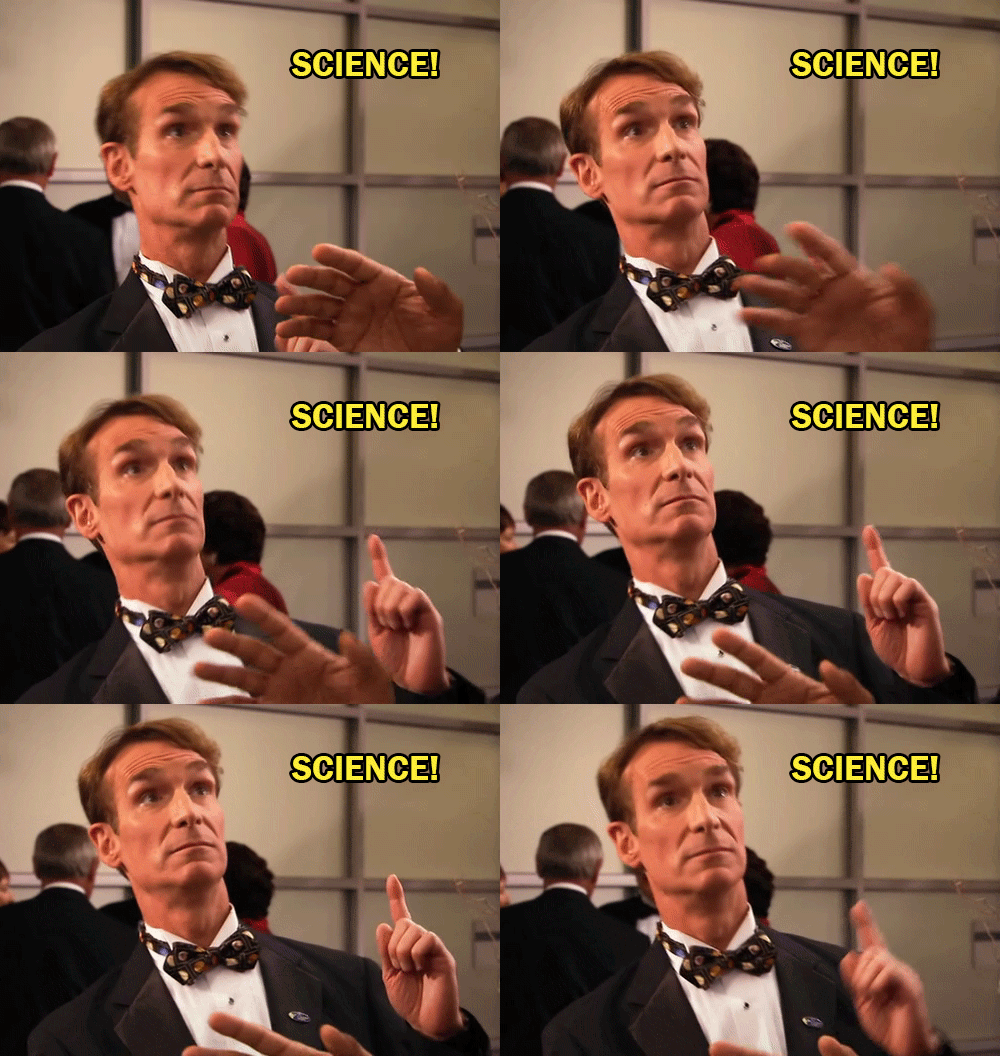
Bill Nye on Dancing with the Stars, sea otters, etc.


Many people think writing is just for English majors, but actually, writing is a crucial element of all majors. That’s right, even...


Bill Nye science
Think about it. What good is your mind-blowing experiment on flippy-whatsit isotopes in radioactive sea otters if you cannot clearly relay your process and findings to other scientists? How are you going to inform the public about it if you cannot put it into language the average man or woman could understand?


To be a good scientist, you don't have to be a good dancer, but you do have to be a good writer.

Lab reports--guess what? They are made of writing. Bring your lab report into the writing center so we can talk about structure (there is a proper and expected structure for these things), clarity, and grammar issues. And don’t worry about the fact that the tutor you sit down with may no NOTHING about nuclear physics or the anatomy of the endangered Hawaiian Crow. As it turns out, we can help you with the writing anyway! In fact, we will actually be able to have a more honest and engaging conversation because we’ll have to ask you things like, “Is this a term most people in your field know, or should you define it here?”

All that to say, please don’t feel excluded from the MWC because you’re in a hard sciences major. We would love to see you.

(We also have several tutors who are hard sciences majors, if that sweetens the deal for you at all.)

Cheers,

Gabby

Wednesday, September 11, 2013

What can Miley Cyrus' VMA performance teach us about comma rules?

Absolutely nothing. But her song "We Can't Stop" does invite us to consider the effect of sentence structure on an audience. Take these lyrics, for example:

This is our house
This is our rules

And we can't stop
And we won't stop


Can't you see it's we who own the night?
Can't you see it's we who 'bout that life?


Miley uses a series of short, simple sentences with parallel structures. This strategy gets her basic point across clearly and concisely, and it contributes to the relentless rhythm of the song, especially when you factor in the fact that all her words are only one syllable long. Furthermore, the rhetorical questions at the end invite the audience to engage with the song by addressing them directly.

Her choppy sentence structures works well, but only in her particular context (2013 pop music). If Miley were turning these lyrics in as part of, say, her literary analysis of Hamlet for Comp 1000, I would encourage her to vary and lengthen her sentence structures. I would also challenge her to not reuse the same words over and over again because it signals a lack of effort and can be annoying to read. (Get creative, hypothetical Miley!) I would also kindly remind her that contractions (can't, won't, it's, and 'bout) do not belong in academic papers. Academic papers should be professional, and contractions are casual.

So thanks, Miley, not just for searing bear images into our minds we wish we could forget, but for reminding us how important it is to be aware of audience and context when we write.


Cheers,

Gabby